Liz Sweet

Liz Sweet, with a bachelors in Geology a masters in Palaeobiology and a PHD in Marine Biogeochemistry clearly had a lot going on. Fascinated by the "why" of things she sees connections as she looks at the world and wants to understand how seeming isolated events affect something else and share her knowledge so that anyone can enjoy and understand the world. With her passion laying in science communication, being the scientific advisor and narrator for Wild Islands Film Production and with her platform, The Guernsey Scientist, she has many ways to educate a variety of audiences. She started her career as an oceanographer working across the world and she now works as an Ocean Conservationist for marine conservation charity ORCA, heading out in the sea to collect data and teach people how to look for sea animals. She’s the most happy when she collects data and learn new things while working as a researcher scientist. She also led several citizen science projects, co-founded her local dolphin project in 2019, which now monitors all local cetaceans and trained as a Marine Mammal Observer. In fact while all marine life fascinates her, marine mammals captivate her!
You have such an interesting academic and professional background, was there a turning point when you decided to focus on marine life or was it something you have always wanted?
I remember confidently announcing when I was 6 that I was going to be an oceanographer. In my teens I started down the path to commercial flight school before falling in love with earth sciences at university and ending up back at oceanography via palaeontology. Why? Because plankton are epic and underpin our entire world. It’s through plankton I became obsesse
d with cetaceans. Growing up on an island has definitely influenced my decisions about life.
To make a change we all need to do something, to work together. Do you think the general public understands the urgency of marine issues? If not, what do you think is missing in how we communicate these challenges to people who might not be directly connected to the ocean?
I think the general public is a lot more aware than they used to be, the Blue Planet series sparked a fundamental shift in people. The marketing to discredit anthropogenic (human driven) climate change is objectively impressive in its success. I think the academic community was slow to tackle it. Part of the issue is that scientists tend to avoid definitive language. We say “may cause” instead of X causes Y and climate science is complicated. It’s difficult to distil down to a neat sound bite. What give me great hope for the future is how science communication is now being actively taught as part of degrees. Science should be accessible. Patronising people and expecting them to take our word for granted because we’re experts isn’t the way to engage people. I’m not convinced the urgency is fully understood, yet at the same time, we are in a cost-of living crisis and so many of us are struggling to get by. The reframing of the climate crisis on individuals rather than the corporate world has done huge harm. The focus on reducing carbon emissions often obscures all the other impacts. Social media does so much good amplifying voices and connecting people to issues, but there’s also so much misinformation out there. I don’t think there is one simple piece missing in communicating the issues, but I am sure that diverse voices and grassroots are critical to address the problems.
Having worked in many parts of the world, how has your travel and global perspective influenced the way you approach local conservation efforts?
Hugely! It taught me that the community needs to be involved and buy-in to a project. If they are not onboard, it’s not a them problem, it’s that the project doesn’t address their needs. By community I mean everyone; supporters should reflect the makeup of your local community and if it doesn’t or there is only a very small sector of the community involved then I need to revise things. The most valuable thing we can ask of anyone is their time so it’s up to us to make it easy for people to be involved in conservation. I live on a tiny island where I often hear people say “Guernsey is so tiny we don’t have an impact”. It’s my responsibility to help make these distance concepts local and relatable. My experience helps me see that we are part of the world. So, I explore the beauty and importance of what we have locally and fit it into the global picture, not the other way round.
What has been the most rewarding experience you have had while working on your marine conservation project and regarding your science communication efforts?
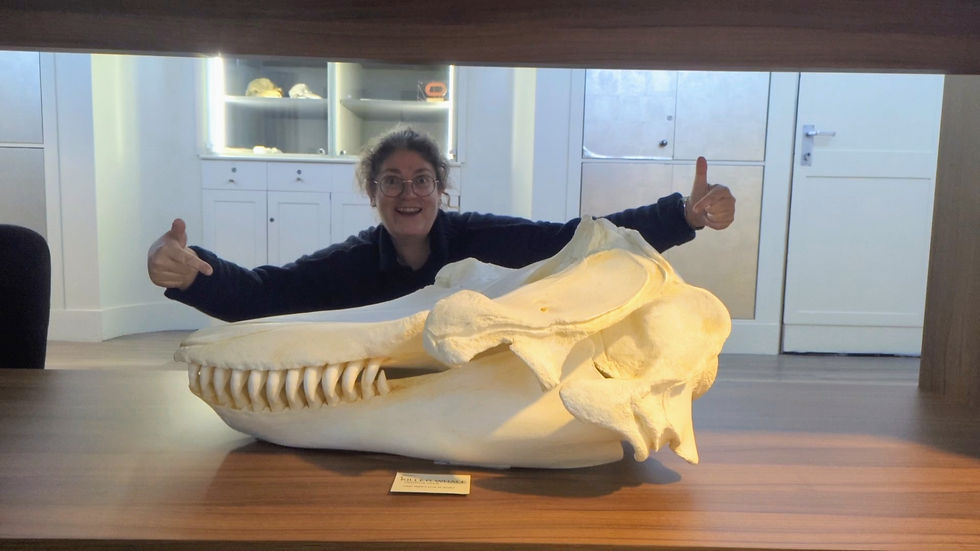
I can’t choose just one. Being asked by Wild Islands to narrate our first short film The Blue about Guernsey’s marine life was probably the moment I realised science communication was my happy place. Every time an old student or intern updates me about their achievements I
want to burst with pride. It’s so much harder for young people than it was back when I was a teen/early 20s and I am humbled by what they achieve. Every time I give a talk is rewarding, whether that’s to a class of 5-year-olds or advising a corporate group, although kids do ask tough questions. My favourite animal encounter though was seeing a humpback whale do a headstand in the Southern Ocean. He literally dived down beside our research ship and then reversed out of the water backwards!
Marine mammals clearly hold a special place in your heart. What is it about these creatures that captivate you and what do you think we need to do to protect them?
I love marine mammals but cetaceans, dolphins, porpoises and whales are so incredible I wrote a whole essay on why they’re awesome. In summary, they keep us alive. No matter how many times I see them, every encounter is as magical as the first time. I’ve filmed cetaceans and as you watch them, they’re looking right back at you and trying to work out what you are. I came to appreciate marine mammals in a rather roundabout way when I was researching phytoplankton in Antarctica. Phytoplankton are tiny, microscopic plants that form the base of the marine food chain. Just like plants in a garden they need nutrients to grow, but sometimes, even if there are a lot of nutrients in the water, we don’t get lots of phytoplankton. We call these High Nutrient, Low Chlorophyll (HNLC) zones and they tend to occur where one nutrient is lacking. Despite huge concentrations of nutrients, the Southern Ocean is home to relatively little phytoplankton biomass (and as a result, has a lower primary productivity than the rest of the sea). In the Southern Ocean the element that is limiting phytoplankton growth is iron. So where is all the iron? It’s locked up in the bodies of marine life, like krill. They are full of iron and when they get eaten and then excreted out by other wildlife like penguins or whales the iron returns to the ocean. I was working at the Alfred-Wegener-Institut (AWI) in Germany when Professor Viktor Smetacek proposed his Iron Fertilisation hypothesis. Basically you add the limited element, iron, back into the ocean then measure and analyse the resulting phytoplankton bloom. From there I became interested in natural marine fertilisers, the largest animals on the planet; whales! Well have you ever seen, or more importantly smelt a whale poo? I have. Whales produce a slurry and literally fertilise the ocean, I like to think of them as the gardeners of the ocean. We massively accelerated the impacts of climate change by hunting whales. They’re ecosystem engineers and just through existing they support ocean’s biodiversity, carbon sequestration or storage and they reduce the impact of climate change through 3 main processes:
Whale pump: transporting nutrients from the bottom of the ocean. Whales can’t poo under pressure and when they return from a deep dive they poo at the surface
Whale fall: by dying and sinking to the bottom of the ocean they move carbon into long term storage. A single humpback can remove 33 tonnes of carbon dioxide from the atmosphere. Estimates vary but a large whale, like the fin whale or blue whale, can actually store as much carbon as 1000 trees. A live oak tree, one of the most efficient carbon-capturing tree species, captures roughly 12 tons of carbon dioxide over a maximum 500-year lifespan
Whale conveyor belt: they move nutrients around the surface of the ocean to new areas
Hunting whales in some countries was justified as whales compete for fish as well as humans but research shows that more whales = more nutrients = more phytoplankton = more small fish and krill.
What should we do to protect them? A really quick win would be for all commercial whaling to end. I’m so disappointed Iceland has announced it is granting whaling licences in 2025. Like many animals they face a lot of threats which include climate change, ocean pollution, prey population decline and ship strike. At least half of all cetacean species are data deficient. That means we don’t have enough data on the species to say whether is it doing well, is endangered etc. So, collecting data and reporting your sightings is a great, personal step. Lots of marine communities have monitoring schemes. If you’re not sure where to start you can just upload sightings and information to iNaturalist. Good data can help create good protection plans.
You definitely are incredibly passionate about marine life, but what do you enjoy doing when you're not working with the sea? Are there any hobbies or activities that help you recharge after work?
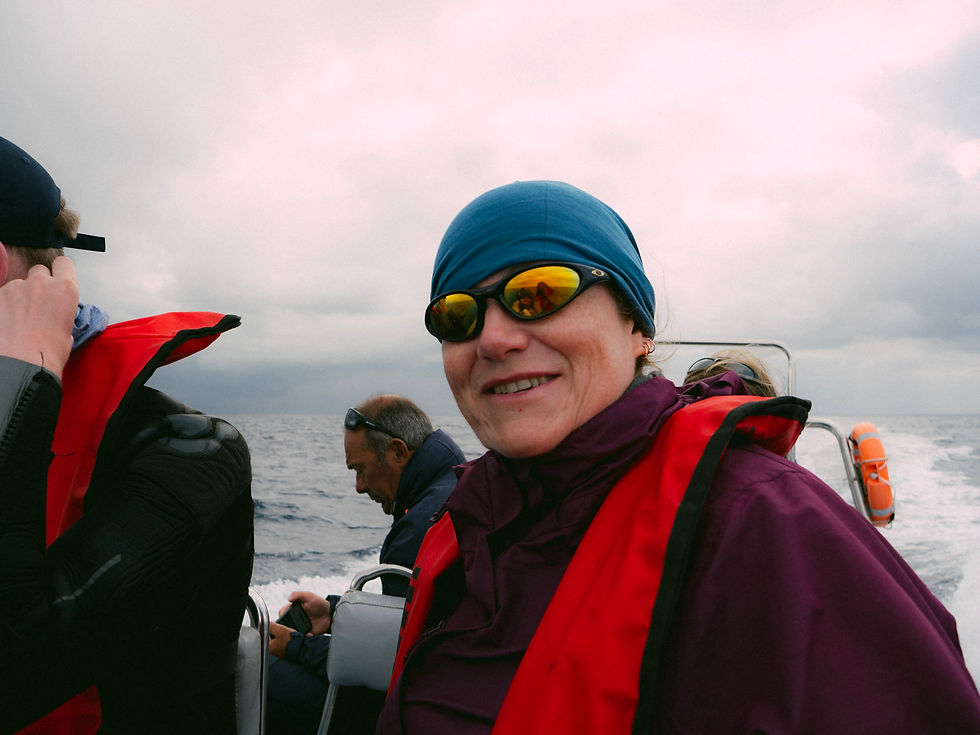
This time of year, I’d love to say I’m active and making the most of daylight but in reality, I tend to hibernate. My home base is Guernsey in the Channel Islands so I’m incredibly lucky that all I have to do to get to the ocean is walk down the hill! I spend a lot of time on the beach, particularly a rocky bay called Belle Greve Bay in my waders and thermals rummaging through rockpools, kelp and seagrass beds looking for marine life. This time of year, I do tend to hibernate in front of the fire, but thankfully my spaniel is a firm believer in being outside, ideally in the rain, so I do get some exercise. I love reading, especially Sci-Fi, solar punk and urban fantasy. Not sure if there’s a name for it, but books exploring indigenous wisdom and mythology’s relationship to science are marvellous and always reinvigorate my drive to understand the world.
What advice would you give to someone wanting to make a difference in any science field but feeling overwhelmed by the scale of the problems we have to face?
There are so many problems I definitely relate to climate and ecological anxiety on occasion. I am really strict about limiting the number of negative media I consume. I have a carefully curated TikTok feed that includes positive research and successes. Try and remember it is our collective responsibility, and it is better that we are all imperfectly improving rather than having one perfect person doing everything. Find uplifting social media accounts to follow. Support BIPOC and female scientists. Work out what area of science you enjoy. My advice to all the student interns I’ve had is to explore what’s going on locally. There is nothing wrong with trying out each local group and seeing if it’s your jam. Embrace trying new things. It is better to explore a lot now, rather than lock yourself into something you think you should do. If you go to college or university try out as many different clubs as you can. You do not need to commit forever. Children are natural scientists, their instinctive curiosity and drive to know why is science. You can be a scientific illustrator, a graphic designer, drone operator, comms officer, gardener and still be a scientist. This is why I’m a huge fan of moving away from STEM and embracing STEAM because without arts, creativity and the ability to communicate no one will understand or care.


Comments